How to Measure Personal Growth When There's No Scoreboard
Sheida ·

Growth rarely moves in a straight line
Personal growth is often obvious looking back and hard to score from one week to the next. You might be learning a skill, getting better at setting boundaries, returning to a routine after a hard stretch, or making decisions that fit your values more closely. None of these necessarily gives you a daily number. Seeing no visible progress doesn't prove nothing is changing, and a rising number can't tell the whole story either. The OECD's framework for subjective well-being separates life evaluation, day-to-day feelings, and what it calls eudaimonic aspects, such as meaning, competence, autonomy, and personal growth.[1] For your own reflection, that's a useful reminder that personal development has several sides. You don't have to turn them all into a formal score. Look for signs of change in the areas that matter to you, and allow for stretches of rest, maintenance, and uncertainty along the way.
Measure more than one kind of change
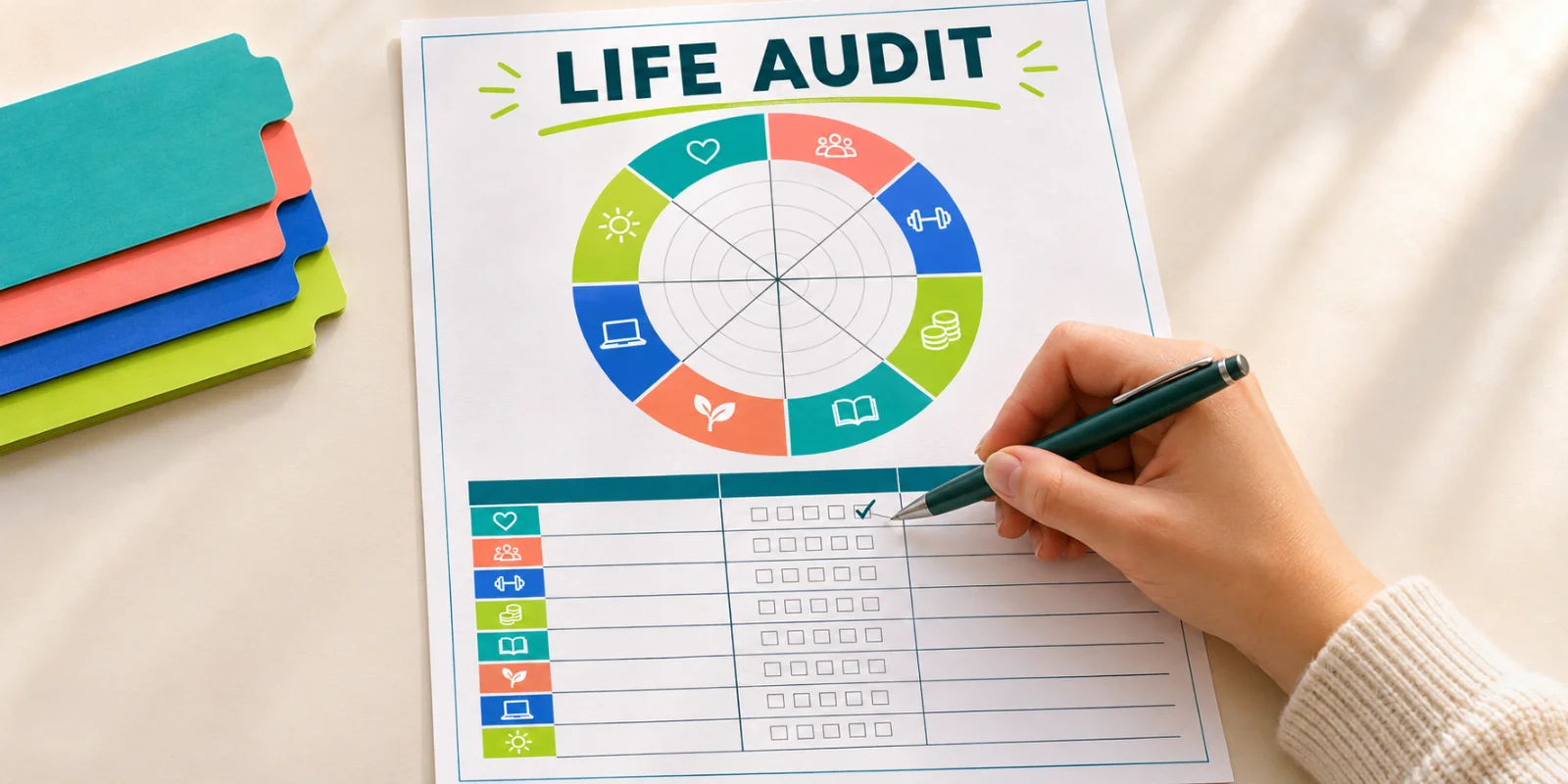
Instead of only asking, "Did I reach the outcome?", look for three kinds of evidence: what you did, what you can do now, and how the experience feels. If you're learning to speak up at work, you might note whether you raised a concern, whether you can explain your point more clearly, and whether those conversations feel less intimidating than they used to. These measure different things, and they don't have to move together. Your skill might grow before you feel confident using it, and your satisfaction might dip while you take on a hard challenge. The Wheel of Life guide is one way to reflect across life areas, and its ratings are there to get you thinking. Put a few simple observations together with your own judgment. One score can't sum up who you're becoming.
Choose a domain and define what growth means to you
Start with one area that matters in this season of your life. "Grow as a person" is too broad to guide a decision. "Be more confident talking about my workload" gives you something specific to notice. Ask why the change matters to you and what it would look like in an ordinary week. Research on the self-concordance model found that people put more effort into goals that matched their own interests and values, and were more likely to reach them. Reaching those goals also went along with better well-being.[2] Goals like that can still be hard, but the research helps you tell your own aims apart from goals you feel you're supposed to want. If a life-area rating has left you unsure what to do next, You Scored 3/10 on a Life Area. Now What? shows how to go from a reflection to one manageable weekly action.
Track actions you can control
Results like a promotion, a stronger relationship, or more confidence can depend on other people and take time to show up. What you can record are the actions that make change possible: practising a skill twice a week, asking for feedback, or protecting time for a conversation. Pick a signal that's easy to capture and relevant to the goal, then look at it over several weeks instead of judging any single day. Habit research suggests that repeating an action in the same context can make it more automatic, although how long that takes varies a lot. In one real-world study, missing a single opportunity didn't materially set back habit formation.[4] So a missed day tells you something, and you don't have to start over. Our guide to building habits without guilt when you miss a day has a practical way to get back on track. Track what you chose to practise, and leave the rest of your life out of it.
Collect examples, not just numbers
Numbers can make change easier to spot, but a short note in your own words often explains what they mean. Once or twice a week, write down one thing you tried, one moment that felt different, and one thing you learned. "I asked for clarification before agreeing to the deadline" tells you more than "confidence: 6/10." You can also save a piece of work, a message, or some feedback that shows a skill developing over time. Be careful about comparing yourself with an earlier version of you from a very different season, because your responsibilities, health, support, and free time may all have changed. Read your records as evidence and decide what they mean. If you have someone you trust, their specific observations can add context, and your own experience still counts. Growth doesn't always mean being more productive or more visibly successful. Sometimes it means noticing a limit sooner, asking for support, or choosing a goal that fits you better.
Review progress without turning it into a grade
Choose a review rhythm that suits the goal, such as a short weekly check-in and a fuller reflection each month. Ask what you practised, what changed, what got in the way, and whether the goal still matters. A meta-analysis of 138 studies found that interventions encouraging people to monitor their progress improved goal attainment on average, with stronger effects when progress was recorded or shared.[3] That supports monitoring with a purpose. You don't need to measure every part of your life, and a missed target says nothing about your character. Our weekly journal review can help you turn what you noticed into one realistic next step. If your record shows little movement, look at the system before you blame yourself. Is the action clear, is there time for it, and do you have the support or resources it needs? Sometimes the most useful outcome of a review is changing the plan or deciding to pause.
Build a small scoreboard that serves you
You can set up a personal progress check without turning your life into a competition. Choose two or three signals that fit the goal: one action you control, one sign that you're learning or getting more capable, and one reflection on whether the change is helping your life. Review them at a steady interval, and drop any measure that adds pressure without helping you decide what to do. Lifous, formerly FocusCrew, puts the Wheel of Life, Planner, habits, focus sessions, and Notes in one place, so you can connect reflection with a practical next step and keep a record that suits you. The tools can support the process, but you decide what counts as progress. Some goals will lead to visible achievements, and others may leave you feeling more capable, more connected, or more at ease. You don't have to prove you're always improving. Notice what's changing, work out what matters, and choose what you want to do next.
References
- OECD. (2025). OECD Guidelines on Measuring Subjective Well-being (2025 Update). OECD Publishing.
- Sheldon, K. M., & Elliot, A. J. (1999). Goal striving, need satisfaction, and longitudinal well-being: The self-concordance model. Journal of Personality and Social Psychology, 76(3), 482–497.
- Harkin, B., Webb, T. L., Chang, B. P. I., Prestwich, A., Conner, M., Kellar, I., Benn, Y., & Sheeran, P. (2016). Does monitoring goal progress promote goal attainment? A meta-analysis of the experimental evidence. Psychological Bulletin, 142(2), 198–229. https://doi.org/10.1037/bul0000025
- Lally, P., van Jaarsveld, C. H. M., Potts, H. W. W., & Wardle, J. (2010). How are habits formed: Modelling habit formation in the real world. European Journal of Social Psychology, 40(6), 998–1009.