How to Do a Personal Life Audit (Free Template)
Sheida ·
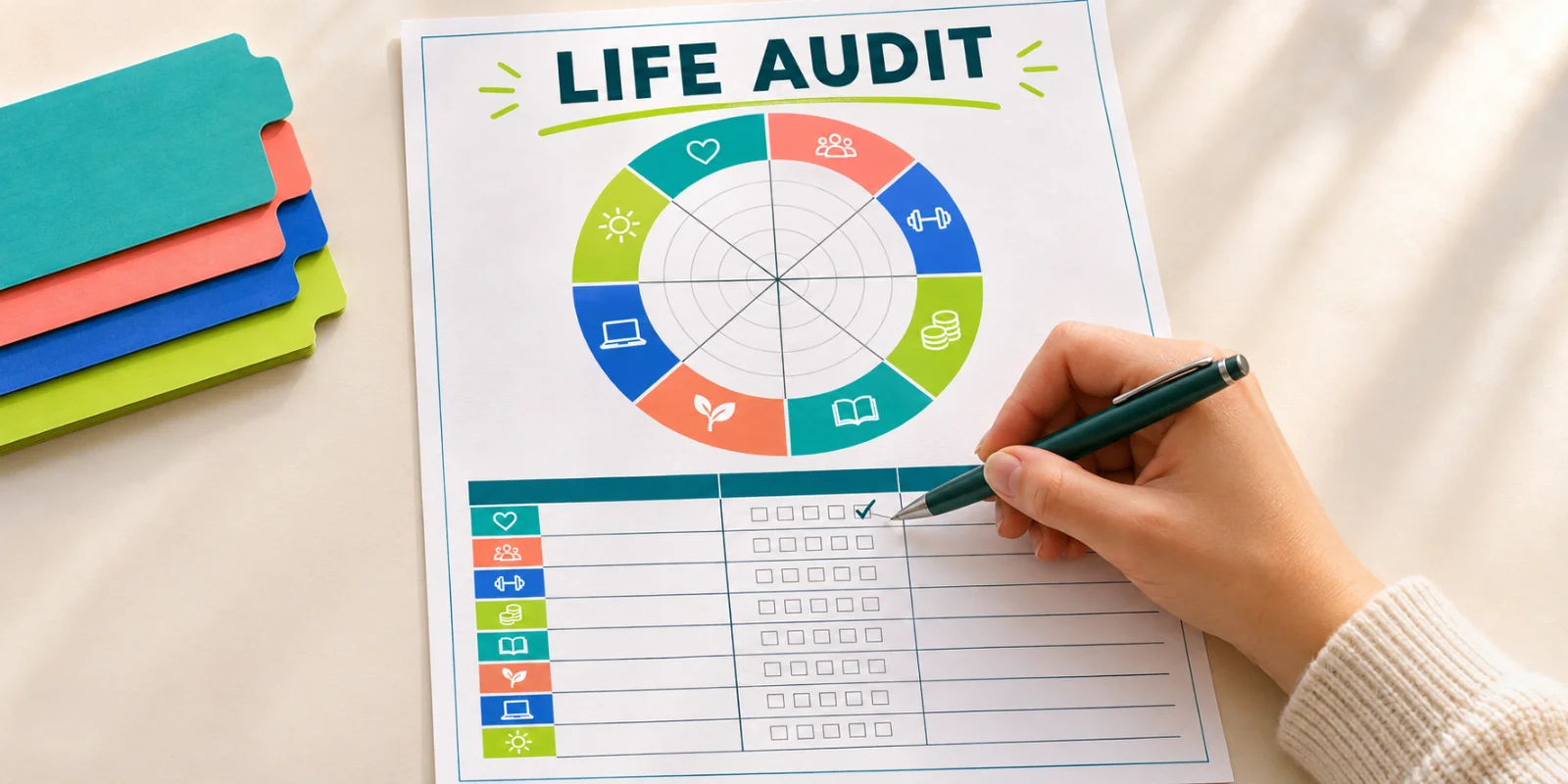
What a personal life audit is
A personal life audit is a structured pause to look at how the different parts of your life are going and decide where you want to put your attention next. Nobody is testing or diagnosing you, and there's no right way to be doing life. Think of it as a snapshot: useful for asking better questions, but never the whole story. Your answers can shift with a deadline, a move, a new responsibility, or a hard week. Well-being research also treats life evaluation, day-to-day feelings, and a sense of meaning as separate parts of subjective well-being, so no single score can describe everything that matters.[1] Set aside about twenty minutes, pick a calm moment, and answer for your life as it's been lately. Leave out the ideal version, and don't judge it by only its best or worst day.
Start with this free life audit template
Use the areas below as a starting point. Add, remove, or rename them so they fit your life and values. For each area, write a satisfaction rating and an importance rating, then add one concrete observation. Leave the next-step column blank for any area you don't want to act on right now. You don't need a perfect, complete assessment. You only need enough information to make one useful choice. Copy the table into a note, a document, or a journal and fill it in at your own pace.
| Life area | Satisfaction (1 to 10) | Importance (1 to 10) | What I notice | One possible next step |
|---|---|---|---|---|
| Health and energy | ||||
| Relationships and connection | ||||
| Work or study | ||||
| Money and security | ||||
| Learning and growth | ||||
| Rest and enjoyment | ||||
| Home and daily environment | ||||
| Meaning and contribution |
Rate satisfaction and importance separately
For satisfaction, ask yourself, "How does this area feel to me right now?" For importance, ask, "How much does this area matter to me in this season of my life?" The two questions are related, but they measure different things. An area can be important to you while you feel unhappy with it, and another can be going well without needing more of your limited attention. A low satisfaction score doesn't automatically mean you have to fix something, and a high one can point to what you want to protect. The Wheel of Life guide is another way to reflect across life areas, and it also treats ratings as clues.[4] Use your own definitions, and don't compare your numbers with anyone else's.
Look for patterns, not faults
Once the table is filled in, read through your observations before you choose a goal. Look for friction that keeps coming up, needs that aren't being met, and things that support you. Maybe your energy drops after a few late nights, you miss a friend whenever work gets busy, or a weekly class gives you a welcome sense of progress. Ask what might be shaping the pattern: your schedule, your resources, your relationships, your health, or circumstances outside your control. Asking that keeps the audit from turning into a list of personal shortcomings. If several areas look difficult, you don't have to work on all of them at once. Choose the one that matters most and that you can do something about, or decide that the most helpful step is to get support. You're reflecting so you can understand your situation well enough to respond in a way that fits it.
Choose one area and one small action
Pick one area to focus on for the next week or two. It doesn't have to be your lowest rating, because importance, timing, and what you can realistically change all count. Turn a broad concern into one action you can see yourself doing. "Improve my relationships" is hard to start on. "Message Maya and ask if she's free for a walk on Saturday" gives you a clear next move. Progress monitoring can help people reach their goals on average, especially when they write their progress down, but that doesn't mean every part of your life needs a tracker.[2] Keep the action small enough to fit around your real responsibilities. For more on this step, see You Scored 3/10 on a Life Area. Now What?, which covers turning a difficult rating into one manageable weekly action.[5]
Turn the idea into a week plan
Give your action a time and a place, and think about what could get in the way. A simple if-then plan can make an intention easier to carry out: "If I finish lunch on Wednesday, then I'll spend ten minutes booking the appointment." Research on implementation intentions looks at exactly this kind of plan, deciding in advance when, where, and how you'll act, and finds that it helps people reach their goals across many studies.[3] Keep the plan flexible. If Wednesday falls through, pick another time and carry on. A short weekly journal review can help you connect what you noticed with a realistic plan for the days ahead.[6] If you'd like one place to keep your notes and your next action, Lifous (formerly FocusCrew) brings reflection and planning together in tools like the Wheel of Life and the Planner.[4]
Revisit the audit without grading yourself
After a few weeks, come back to the same questions and see what changed. Did your action happen? Did it help, or did it show you that you need a different kind of support? Has the area become more or less important to you? Write down what you learned, including what went well, as well as whether you hit your target. Repeat the audit when life changes or when you want a fresh overview. There's no need to turn it into a weekly scorecard. If your ratings haven't moved, that tells you something too, and it doesn't mean you failed. A good life audit leaves room for changing priorities, practical limits, and the parts of your life that are already working. Notice, choose one next step, try it, and review it whenever that's useful to you.
References
- OECD. OECD Guidelines on Measuring Subjective Well-being (2025 Update).
- Harkin, B., et al. (2016). Does monitoring goal progress promote goal attainment? A meta-analysis of the experimental evidence. Psychological Bulletin, 142(2), 198–229.
- Gollwitzer, P. M., & Sheeran, P. (2006). Implementation intentions and goal achievement: A meta-analysis of effects and processes. Advances in Experimental Social Psychology, 38, 69–119.
- Lifous (formerly FocusCrew). What Is the Wheel of Life? A Practical Guide to Assessing Your Life in 10 Minutes.
- Lifous (formerly FocusCrew). You Scored 3/10 on a Life Area. Now What? Turning a Low Score Into One Weekly Action.
- Lifous (formerly FocusCrew). A Weekly Journal Review in FocusCrew: Turn Reflection Into a Realistic Plan.