Why "Work-Life Balance" Is the Wrong Goal
Sheida ·

The problem with a perfect split
"Work-life balance" sounds like a clear destination: work ends, personal life starts, and each gets a fair share. But what counts as fair changes from person to person and season to season. A week spent caring for family, studying for an exam, or finishing a deadline can be lopsided and still be right for you. Wanting room for a life outside work is fine. The trouble starts when a fixed 50/50 split, or a daily ratio of hours, becomes your proof that you're doing well. The OECD measures quality of life across separate dimensions, including work, health, relationships, and subjective well-being, and doesn't boil it down to one universal number.[1] A better question is whether your current pattern supports the life you care about, and what signs would tell you it needs adjusting. Balance still works as a general aim. It only becomes a bad goal when you grade every day against the same formula.
Track fit across the areas that matter
Skip counting every hour. Once a week, check three things: how satisfied you are with one important area of your life, whether you had a chance to recover, and whether you moved one priority forward. Each of these tells you something different. A satisfying week isn't always a relaxed one, and a busy week doesn't mean you made progress on anything you care about. You don't need to score every part of your life each day or build a complicated dashboard. A short check-in is enough if it tells you what to keep, what to change, and what to ask for. Tracking is there to make your choices clearer, and it shouldn't turn into another performance target. Start with one area that matters right now, and change the questions when your responsibilities or priorities change.
Measure satisfaction in each area, not an even pie
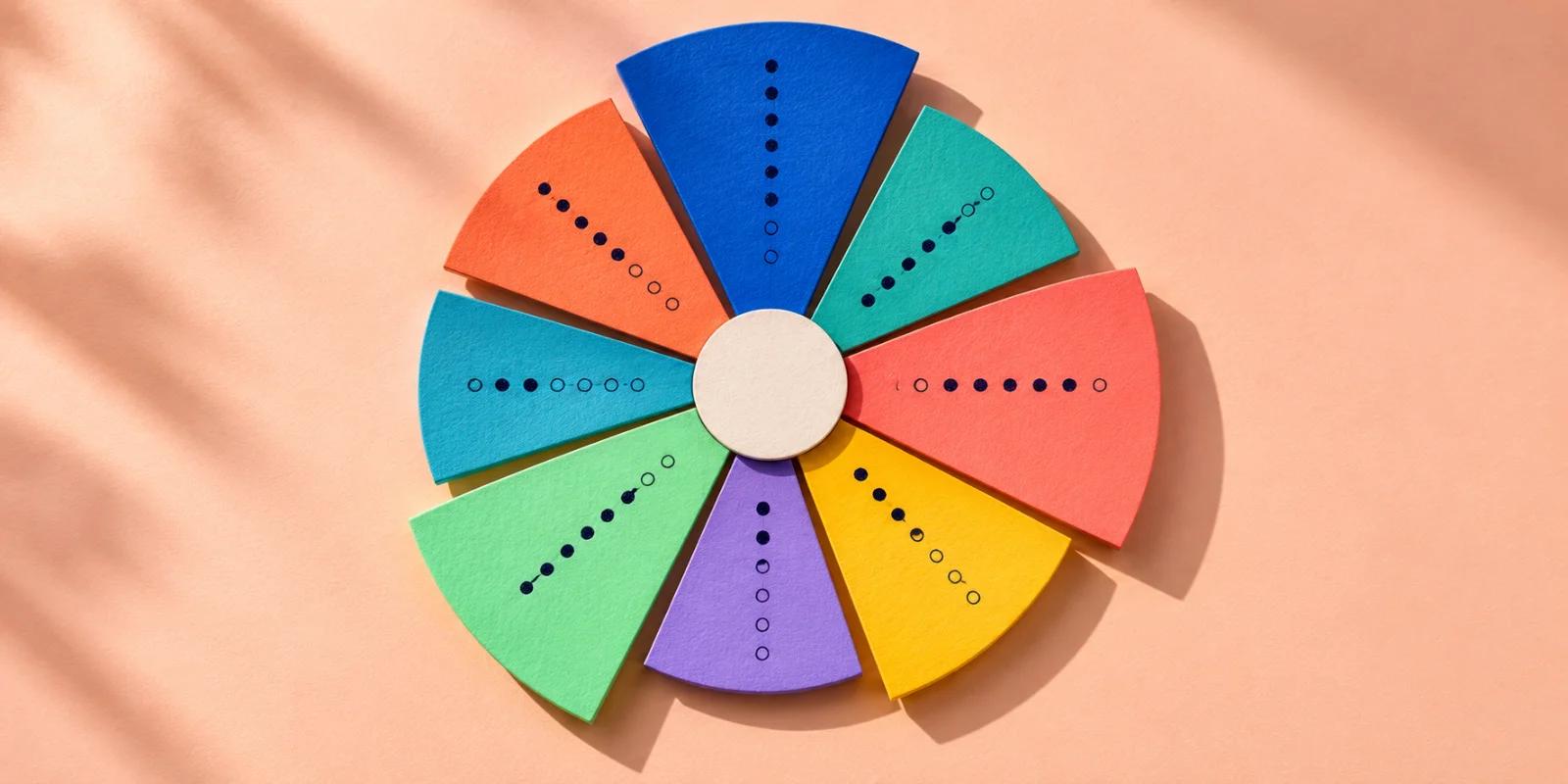
Ask yourself, "How satisfied am I with this part of my life right now?" and "How important is it to me this month?" Work, health, close relationships, learning, money, and free time may all matter, but they don't need the same amount of time. Lifous has a Wheel of Life where you can rate eight areas, note how important each one is and which way you want it to move, and explore optional prompts.[2] It helps you see whether your work pattern is crowding out other priorities, so you don't assume that equal hours add up to a good life. Treat the score as a snapshot of the moment. For a walkthrough, see the Wheel of Life guide. You might check one area at a monthly review, then leave the number alone while you try a small change.
Notice recovery, not just time away
Hours outside work tell you when work stopped. They don't tell you whether you managed to switch off, or whether you got to choose how to spend that time. Recovery research separates out experiences such as psychological detachment, relaxation, mastery, and control over your leisure time.[3] You can turn these into simple questions. Was there a stretch when work wasn't on my mind? Did I do something restful or absorbing? Did my free time feel like mine to choose? You don't need to measure all four, or turn rest into an achievement streak. Pick the one that's been missing and plan a realistic chance for it. If you often finish work and then keep checking messages, a boundary like muting notifications during dinner may help more than adding another hour to your calendar. A weekly journal review can help you spot recurring patterns without relying on memory alone.
Track one priority moving forward
Choose one action that would make an important area feel a little better, and note whether you tried it. "Spend more time with my family" is hard to check. "Put my phone away at dinner on Tuesday" is a clear experiment. "Develop my skills" might become "finish one lesson on Thursday evening." In a meta-analysis, interventions that had people monitor their progress improved goal attainment on average, especially when the progress was recorded.[4] That's a case for tracking one chosen action. You don't need to log every minute or expect a perfect week. In Lifous, the reflection can link to a dated to-do or a habit, so the next step sits in the planning tools you already use. Leave room to change the plan if it doesn't fit. A realistic daily priority will get you further than an ambitious list that ignores your time and energy.
Watch boundaries and trade-offs
Notice where work keeps spilling into time you meant for something else, and what causes it. Is it a late meeting, an unclear deadline, a long commute, caring responsibilities, or your own habit of checking messages? The answer matters, because individual discipline can't fix every imbalance. Some changes are yours to make, like setting a cue to stop or moving a task. Others need a conversation, a change in workload, or help from someone else. Write down one friction point that keeps coming up, one thing that helped, and one request or boundary worth testing. If you want to turn a routine into a small repeatable practice, Lifous can track it as a habit, and its habits-without-guilt approach leaves room to adjust after a missed day. Use what you record to make decisions. It doesn't prove that fixing the system around you is your job alone.
Use a weekly check-in to adjust
At the end of the week, ask three short questions. Which area mattered most? Did I get a real chance to recover? What one priority did I move forward, and what got in the way? Keep the answers brief. If the same friction shows up for several weeks, decide whether to change the routine, renegotiate a boundary, or ask for help. If things feel workable, note what helped so you can do it again. Lifous puts the Wheel of Life next to its planning and habit tools, so a broad reflection can lead to one small choice you can track. That's a goal you can adjust as you go, which a permanent 50/50 split never is. Let the signals guide a change that fits this season, and let what you measure change when your life does.
References
- OECD. (2025). OECD Guidelines on Measuring Subjective Well-being: 2025 Update. OECD Publishing.
- Lifous (formerly FocusCrew). What Is the Wheel of Life? A Practical Guide to Assessing Your Life in 10 Minutes.
- Sonnentag, S., & Fritz, C. (2007). The Recovery Experience Questionnaire: Development and validation of a measure for assessing recuperation and unwinding from work. Journal of Occupational Health Psychology, 12(3), 204–221.
- Harkin, B., et al. (2016). Does monitoring goal progress promote goal attainment? A meta-analysis of the experimental evidence. Psychological Bulletin, 142(2), 198–229.